construction

Building an ankle wedge

Something I’ve realized over the past year where I’ve been building my R2, is that I really love scratch building things from styrene.

Styrene is very forgiving, and once you’ve learned how, making things is actually quite easy!

Today’ I set out to build a small silly piece with lots of weird angles and stuff: An ankle Wedge! (Actually I built two of them, but who’s couting… I need 4 in total, so halfway there… unless I cave in and use the two resin ones that I do have laying around…)

Anyway, back on track! The ankle wedge is a small piece that is sitting on the bottom of the legs, holding the Ankle Cylinder.

I’ve previously built my ankle cylinders out of PVC pipe and styrene, and even though they still need a bit of work, they sit good enough on my robot in order to me to make the wedges!

These are the main pieces. A big piece of styrene, with no straight angles. The short edge will be closest to the ankle, and the big end will rest on the cylinder. The sides are made up by small triangular pieces. I’ve cut out larger triangles, measure, then place a piece of extra pipe on top my 1mm styrene piece and cut around it (had to cut a few times to get the proper fit) to get the right curve.

This is really a try/test/try/test again sort of procedure in order to get these to sit snug, but after a few test tries, I did get my triangular piece to sit pretty spot on to the cylinder.

Once the triangular pieces are made (be sure to mark them properly so you know which side is which, what is in, what is out, etc) I chamfered the long edge of the flat styrene piece, to make it look good on the cylinder. Then glue time!

Two pieces of tape to hold the triangles to the large piece of styrene, and then just glue it all down!

Once the glue set, I added another piece in the center, just for stability.

Then time to use my secret instrument to make it fit really well…

No, not THAT kind of instrument. It’s not a plastic didgeridoo!

However, the PVC pipe with a piece of sand paper strapped on to it, makes for a perfect tool to sand the little wedge to remove any irregularities after glueing it all together!

Finally, let’s end this brief tutorial with taking a look at the results!

Nice and smooth! Now I just need to paint them blue and set aside as finished!

Oh yeah.. need to make another two… unless I use them old resin ones.. I kinda like these better, and they fit SO much nicer…

By |2016-12-06T00:01:09+01:00October 11th, 2012|R2-D2|Comments Off on Building an ankle wedge

Second side vent

First off:

Woohoo! I can has superglue!

The first side vent is therefor complete!

After trying out the “can opener” method on parts of the first vent, I decided to try this out fully on this second vent.

I drilled a large hole (10mm) in the middle of the parts that should be cut out from the second side vent. Just one hole per cutaway rib.

After that was done, I scored fairly deep with my breakblade knife, inserted my pliers in the big hole in the middle, and started rolling the pieces away, and they rolled off nicely!

Fairly good result after I’ve removed the pieces, too!

Since I didn’t drill in the edges, but merely score the short ends, these broke off nice and easily. Don’t worry about it being a bit crooked, I’ve got a solution for that!

My trusty stel ruler laid on top of the vent, and then bang onto the ruler with my plastic hammer, and that seems to work well.

The last few dents was just taken out with my sander.

Not a bad result, and this was done with a minimum of filing, and the corners came out great!

Now, it’s late at night, and I’ve finished glueing my 2mm aluminum clad styrene strips to the back. It’s left to set over night, and tomorrow I’ll paint and add the backing to this second side vent.

Three down, one to go.

Why was I worried about these aluminium vents to begin with? Once I found a method that I liked, it was really a breeze! =)


By |2016-12-06T00:01:10+01:00October 8th, 2012|R2-D2|Comments Off on Second side vent

Side vents: do they work as well?

After my initial attempts (that was quite successful) at making the pocket vents, I set out to do a side vent as well today. Mainly because I like to mix things around a bit and not do too many repetative things after another. This would be similar, but different. The pieces are larger and could therefor be slightly more unstable when cutting..

As usual I’ve started with a printout of the vent, and glued this (with repositionable spray glue) on to a piece of 0.8mm aluminium.

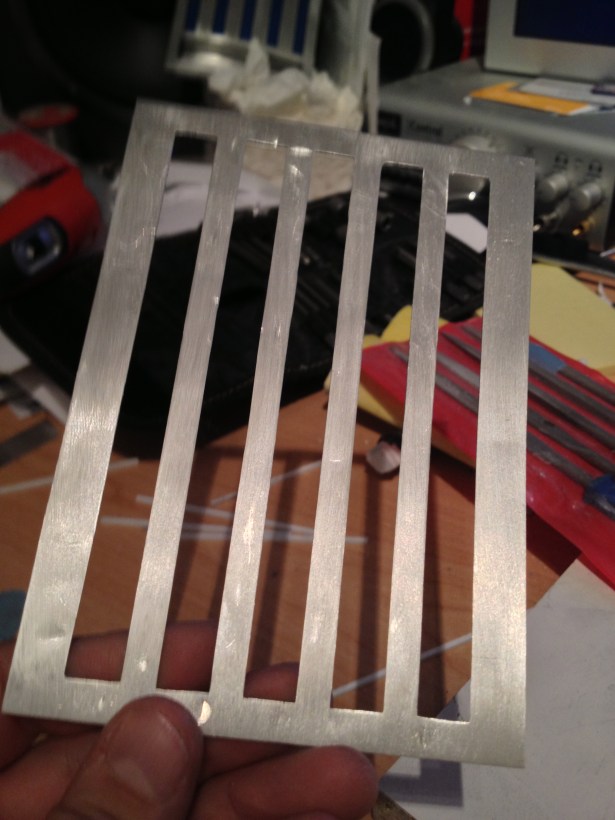
Next step was to mark holes near the corners (no need for precision this time, I’m trying another route) and drill them. I also added a larger hole right near the smaller ones, I’ll explain why in a moment.

Holes drilled, all ready for the next step!

Next step is to score two-three times along the lines on what should get cut out. I made the holes bigger in one end, in order to make room for my pliers to get inside, and try out the “wiggle” thing I made for the pocket vents. In hindsight, the smaller holes at the bottom of the picture above was really not needed. Next time, I’ll do without them!

I also scored the short edges, as best as I could. I took great care to mark where to cut so not get mixed up or my view obscured by my steel ruler.

For each of the lines, I scored a number of times extra, this time with no ruler needed, and then inserted my pair of pliers and started wiggling back and forth, sort of doing a score and snap, but with small increments. I did this on both sides of the piece being cut out, and bent away.

It actually worked quite well. I had scored quite deeply, enough to make the line visible through the aluminum, and bent of small pieces, cut them off with my steel plate scissors, bent of another piece and so forth. Once I got to the other end, the holes function as to create a “stop tab” so I couldn’t bend too much.

after a while, I decided to try another approach, just because I felt it took too much time bending it off in small pieces. I basically used the same method used when opening tin cans!

I bent over a piece, turned the entire piece upside down, grabbed it from the other side and started rolling! This worked even better, and I didn’t need to stop along the way, but could roll off the entire length with only a little extra scoring.

I was a little worried that the edges and the plate would be a little too much manhandled, but after all, I was using quite soft and thin aluminium plate.

The straighter lines was the places where I rolled off the entire length as described, while the more beat up lines is where I started wiggling in small pieces.

This is after I had done one session of straightening the piece out!

Straightening out was actually quite easy. I placed my steel ruler along one of the ribs on top of my cutting mat, and use a rubber mallet and pounted on top of my steel ruler, taking sure not to hit the plate. That made it nice and smooth with quite a little effort.

This is the same piece after filing and sanding the front. Quite a big difference, huh?

The obligatory test fit looks good…

Next up is taking the 2x2mm styrene eEergreen strips, and cutting off strips of aluminum tape to dress them. I found a better version of doing this after a while as well..

The set it into place… and glue..

… and wait for it to set. Rinse and repeat…

By lining up several strips at once on a single piece of tape with a good distance in-between… and rubbing down on the aluminium tape from the other side..

.. and then cutting the tape in between the styrene strips, and folding the tape down, this was a MUCH quicker way to make all the ribs at the same time!

So, placing, glueing and fixating until it sets.. It was all smooth sailing until…

OH NOES! I RAN OUT OF CA GLUE!!!

So, finalizing this part will have to wait a bit until I can get out to the store and buy some of the good stuff again. I tried glueing with a lesser brand that I had at home, but the only thing it really managed to glue together was what it was evidentally made for: MY FINGERS!

So, while waiting for the glue I had to (possibly) set on something else apart from skin, I cut out the back plate..

Paint it in your favourite R2 blue…

Even though I cannot glue this into place at the moment, I can still push it against the back to get an idea what the finished vent will look like:

So, my next set of vents will go a lot faster now that I’ve found better ways to do the ribs and also to cut out the pieces!

By |2016-12-06T00:01:11+01:00October 7th, 2012|R2-D2|Comments Off on Side vents: do they work as well?
Go to Top